


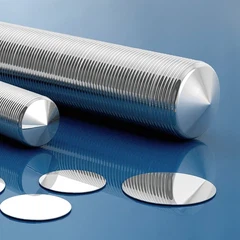




1. Substrate
1. Definition and function
·Physical support: The substrate is the carrier of the semiconductor device, usually a circular or square single crystal wafer (such as a silicon wafer).
·Crystal template: Provides a template for atomic arrangement for epitaxial layer growth to ensure that the epitaxial layer is consistent with the substrate crystal structure (homoepitaxial) or matches (heteroepitaxial).
·Electrical basis: Part of the substrate directly participates in the conduction of the device (such as silicon-based power devices), or acts as an insulator to isolate the circuit (such as a sapphire substrate).
2. Comparison of mainstream substrate materials
|
Materials |
Features |
Typical applications |
|
Silicon (Si) |
Low cost, mature technology, medium thermal conductivity |
Integrated circuits, MOSFET, IGBT |
|
Sapphire (Al₂O₃) |
Insulation, high temperature resistance, large lattice mismatch (up to 13% with GaN) |
GaN-based LEDs, RF devices |
|
Silicon Carbide (SiC) |
High thermal conductivity, high breakdown field strength, high temperature resistance |
Electric vehicle power modules, 5G base station RF devices |
|
Gallium Arsenide (GaAs) |
Excellent high frequency characteristics, direct band gap |
RF chips, laser diodes, solar cells |
|
Gallium nitride (GaN) |
high electron mobility, high voltage resistance |
fast charging adapter, millimeter wave communication devices |
3. Core considerations for substrate selection
· Lattice matching: reduce epitaxial layer defects (e.g. GaN/sapphire lattice mismatch reaches 13%, requiring a buffer layer).
· Thermal expansion coefficient matching: avoid stress cracking caused by temperature changes.
· Cost and process compatibility: For example, silicon substrates dominate the mainstream due to mature processes.

2. Epitaxial Layer
1. Definition and Purpose
Epitaxial growth: Deposition of single crystal thin film on the substrate surface by chemical or physical methods, with the atomic arrangement strictly aligned with the substrate.
Core Functions:
- Improve material purity (the substrate may contain impurities).
- Build heterogeneous structures (such as GaAs/AlGaAs quantum wells).
- Isolate substrate defects (such as micropipe defects on SiC substrates).
2. Classification of Epitaxial Technology
|
Technology |
Principle |
Features |
Applicable materials |
|
MOCVD |
Metal organic source + gas reaction (such as TMGa + NH₃ to generate GaN) |
Suitable for compound semiconductors, mass production |
GaN, GaAs, InP |
|
MBE |
Molecular beam layer-by-layer deposition under ultra-high vacuum |
Atomic-level control, slow growth rate, high cost |
Superlattice, quantum dots |
|
LPCVD |
Thermal decomposition of silicon source gas (such as SiH₄) under low pressure |
Mainstream silicon epitaxy technology, good uniformity |
Si, SiGe |
|
HVPE |
High temperature halide vapor phase epitaxy |
Fast growth rate, suitable for thick films (such as GaN substrates) |
GaN, ZnO |
3. Key parameters of epitaxial layer design
- Thickness: from a few nanometers (quantum well) to tens of microns (epilayer of power devices).
- Doping: Precisely control the carrier concentration by doping impurities such as phosphorus (N-type) and boron (P-type).
- Interface quality: Lattice mismatch needs to be alleviated by buffer layer (such as GaN/AlN) or strained superlattice.
4. Challenges and solutions of heteroepitaxial growth
- Lattice mismatch:
- Gradient buffer layer: Gradually change the composition from substrate to epitaxial layer (such as AlGaN gradient layer).
- Low-temperature nucleation layer: Grow thin layers at low temperature to reduce stress (such as low-temperature AlN nucleation layer of GaN).
- Thermal mismatch: Select a combination of materials with similar thermal expansion coefficients, or use a flexible interface design.

3. Synergistic application cases of substrate and epitaxy
Case 1: GaN-based LED
Substrate: sapphire (low cost, insulation).
Epitaxial structure:
- Buffer layer (AlN or low-temperature GaN) → Reduce lattice mismatch defects.
- N-type GaN layer → Provide electrons.
- InGaN/GaN multi-quantum well → Light-emitting layer.
- P-type GaN layer → Provide holes.
Result: Defect density is as low as 10⁸ cm⁻², and luminous efficiency is significantly improved.

Case 2: SiC power MOSFET
Substrate: 4H-SiC single crystal (withstand voltage up to 10 kV).
Epitaxial layer:
- N-type SiC drift layer (thickness 10-100 μm) → withstand high voltage.
- P-type SiC base region → control channel formation.
Advantages: 90% lower on-resistance than silicon devices, 5 times faster switching speed.

Case 3: Silicon-based GaN RF devices
Substrate: High-resistance silicon (low cost, easy to integrate).
Epitaxial layer:
- AlN nucleation layer → alleviates the lattice mismatch between Si and GaN (16%).
- GaN buffer layer → captures defects and prevents them from extending to the active layer.
- AlGaN/GaN heterojunction → forms a high electron mobility channel (HEMT).
Application: 5G base station power amplifier, with a frequency of more than 28 GHz.


