


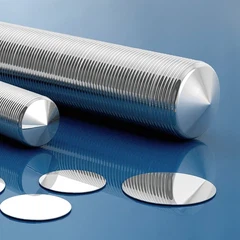



In X-ray diffraction (XRD) experiments, using a zero-background substrate can significantly reduce interference from the substrate itself to the sample diffraction signal, resulting in higher quality diffraction patterns. Crystal orientation selection is one of the core factors to achieve zero-background performance.

Core Principle
The crystal orientation selection for zero-background substrates follows a simple principle: Place the main diffraction peak of the silicon substrate outside the commonly used 2θ scanning range of experiments, thus avoiding interference with the diffraction signal from the sample itself.
The scanning range of conventional powder XRD experiments is mostly concentrated in 5° - 90° (2θ), so it is necessary to select a special crystal orientation such that the characteristic diffraction peak of silicon appears outside this range.
Commonly Used Special Orientations
1. <510> Orientation
- Diffraction Characteristics: The main diffraction peak of silicon appears at a relatively high 2θ angle, which exceeds the commonly used scanning range of conventional XRD experiments. Therefore, almost no obvious silicon substrate diffraction peak will appear in the range of 5°-90°.
- Advantages: Excellent zero-background performance, currently the most commonly used zero-background substrate orientation in scientific research.
- Applicability: Recommended for most conventional XRD experiments, especially powder XRD and low-angle XRD testing.
2. <511> Orientation
- Diffraction Characteristics: Similar to <510>, its characteristic diffraction peak is also located outside the conventional experimental range and will not cause significant interference to the sample signal.
- Advantages: Also provides excellent zero-background performance.
- Applicability: Another mainstream choice, some researchers prefer this orientation based on instrument configuration or experimental habits.
Why Conventional Orientations Are Not Suitable?

The most common silicon wafer orientations on the market are <100> and <111>, but they are not suitable for zero-background substrates:
|
Conventional Orientation |
Main Diffraction Peak (2θ) |
Problem |
|
<100> |
Si(400) peak ~69° |
Falls exactly within the commonly used test range, producing a strong substrate peak that seriously interferes with the sample signal |
|
<111> |
Si(111) peak ~28° |
Located in the center of the conventional test range, interference is even more pronounced |
Therefore, although conventional orientations are readily available, they are absolutely not recommended for zero-background XRD experiments.
Orientation Selection Guide
- Select based on test range: If your experiment mainly focuses on the low-angle region (small-angle XRD), both <510> and <511> can meet the demand, and both have good zero-background effects.
- Select based on personal habit: Different laboratories may have traditional usage habits. Both orientations are widely accepted in academia, and you can choose according to your own experience.
- Small batch customization: Special orientations cannot be obtained from conventional inventory and require customized cutting. We support small-batch customization of both <510> and <511> orientations, with a minimum order of 5 pieces.
Summary Table
|
Orientation |
Zero-Background Performance |
Availability |
Recommendation |
|
<510> |
⭐⭐⭐⭐⭐ |
Customizable |
🌟🌟🌟🌟🌟 |
|
<511> |
⭐⭐⭐⭐⭐ |
Customizable |
🌟🌟🌟🌟 |
|
<100> |
❌ |
In Stock |
❌ |
|
<111> |
❌ |
In Stock |
❌ |
About Us
Ningbo Sibranch Microelectronics Technology Co., Ltd. can customize and provide <510> or <511> orientation XRD zero-background substrate silicon wafers according to research requirements. We support special sizes, thicknesses, and surface treatment requirements, and accept small batch orders.
Website: www.sibranch.com | https://www.sibranchwafer.com/
Official WeChat Account: Sibranch Electronics
For customization inquiries, please feel free to contact us.


